


Invest
Rubey connects retail investors to iconic assets starting from 250€ and provides qualified investors with curated opportunities starting from 25k€, all through a secure and regulated digital ecosystem.
WANT TO STAY INFORMED ABOUT RUBEY? SUBSCRIBE.
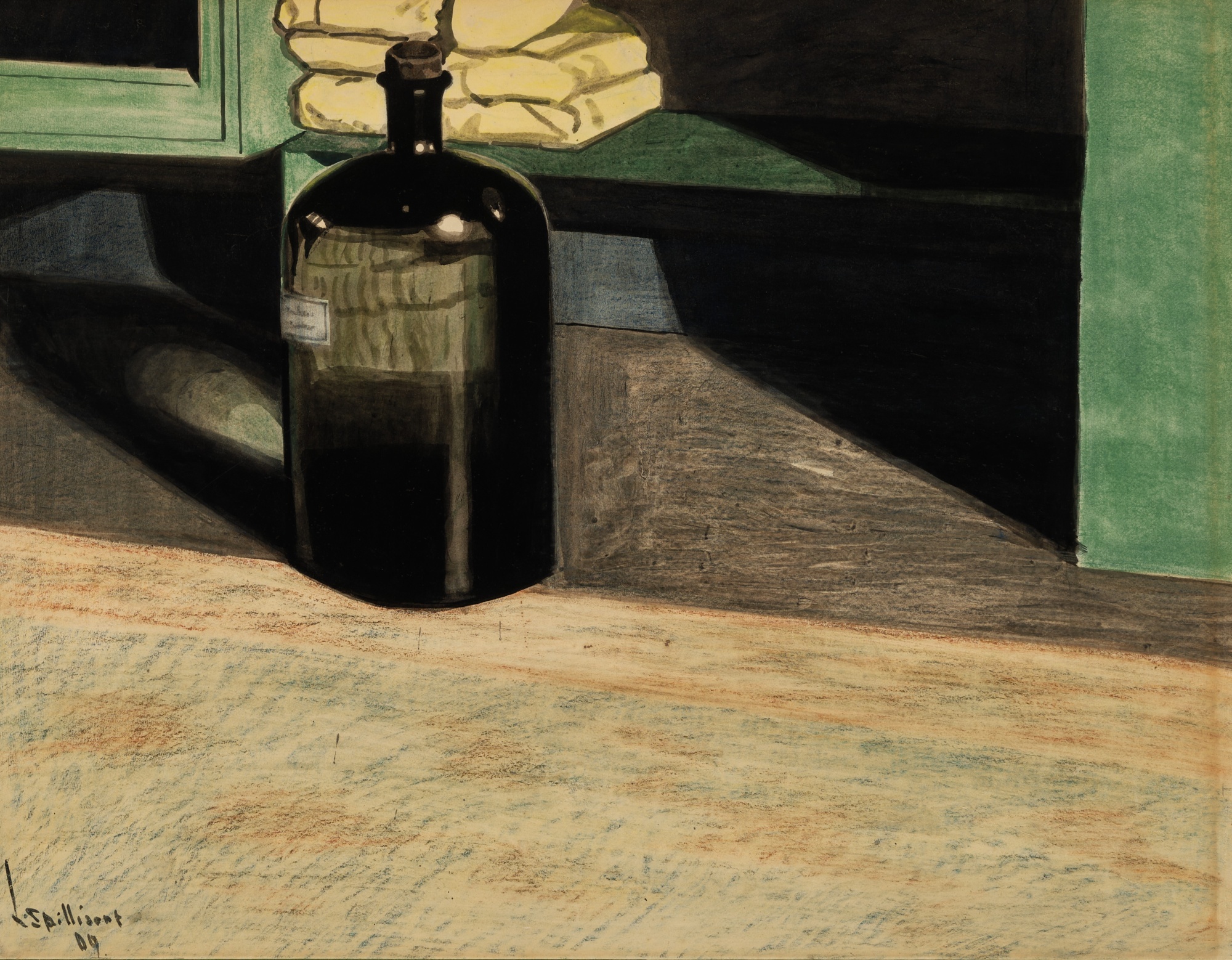
Created in 1909, Flask on the Floor is a striking example of Léon Spilliaert's ability to transform everyday objects into contemplative and psychologically charged compositions.
Executed in coloured pencil and pastel on paper, the work reflects the artist's distinctive visual language, characterised by dramatic contrasts of light and shadow, refined simplicity, and a profound sense of stillness.
Explore the artwork, its historical context, and the investment opportunity below.
Léon Spilliaert (1881–1946) was a self-taught Belgian artist from Ostend whose most distinctive works were made on paper rather than canvas.
His psychologically charged imagery, nocturnal atmosphere, radical cropping and refined use of ink, watercolour, pastel and coloured pencil place him at the intersection of Symbolism, early modernism and a highly personal graphic language.
Léon Spilliaert (1881–1946) was a visionary Belgian artist known for his haunting, atmospheric works that hover between Symbolism and early Expressionism.
Choosing paper, India ink, pastel, and watercolor over traditional oil paint, he created a highly distinct, graphic style characterized by deep shadows and luminous contrasts.
While most famous for his melancholic landscapes of the Ostend coast and introspective self-portraits, his enigmatic still lifes are equally essential to his practice, transforming everyday, mundane objects into uncanny symbols of mystery.
His work frequently captures a profound sense of solitude and existential dread, reflecting the quiet anxiety of the modern soul. Ultimately, Spilliaert’s radical use of empty space and simplified forms across all genres makes him a uniquely independent pioneer of modern art.
The core of Léon Spilliaert’s structural legacy resides in his home country of Belgium, alongside selective representations in major international institutions.
Belgium:
International Presence:
Spilliaert was a “painter without paint,” a self-taught artist, an Ostend native shaped by place, an artist constantly on the move, without a proper studio. Together these qualities explain why his best works feel both intimate and radical: materially modest, but visually and psychologically ambitious.

Recent institutional milestones and top-tier market validation signal a profound global reappraisal of Spilliaert’s practice, shifting him from a well-kept Belgian secret to an essential pioneer of early European modernism.

We’re delighted that this new work by Léon Spilliaert comes with a tangible link to the very first masterpiece Rubey ever offered: James Ensor’s Carnaval de Binche.
For Rubey, the link to James Ensor is both geographic and art-historical.
Spilliaert was inspired by Ensor in Ostend, and the city walk around Spilliaert presents his ties with artists such as Permeke and Ensor.
The connection is not one of imitation, but of shared context. Ensor’s Ostend is theatrical, social and mask-filled; Spilliaert’s Ostend is quieter, interiorised and psychologically suspended. Together they form two complementary modern visions of Ostend, which makes a Rubey narrative bridge between the two artists natural and credible.

A rare, museum-grade still life from Spilliaert’s decisive pre-1910 period.
A single dark flask stands before a green cabinet and folded towels, with strong lateral light casting a deep shadow that turns the bottle into an almost abstract vertical form. The composition is stark, tightly cropped and unusually concentrated, using Indian ink wash, watercolour, pastel and coloured pencil to balance dense blacks with muted greens and ochres.
Medium: India ink wash, watercolour, pastel and coloured pencil on paper
Dimensions: 48.2 x 62.3 cm
Date: 1909
Status: Rubey Collection

The artwork directly reflects Spilliaert’s youth in Ostend, where his father operated a prominent hair salon and perfumery. Because of this familial environment, the flask is not a random decorative object but a form deeply rooted in his early, everyday visual surroundings. In this specific piece, the artist masterfully transforms this familiar memory from his father's shop into a profound, internalized mental symbol.
Iconographically, the work breaks away from traditional, decorative vanitas symbolism by opting for a radically minimalist composition. The unusual placement of the black flask on the bare floor deliberately strips the object of its functional, everyday context. Consequently, the flask transforms into an enigmatic, almost human presence that makes existential solitude and human absence inside the room tangible.
Flask on the Floor dates from 1909, the absolute peak period in which Spilliaert developed his most radical and highly sought-after visual language. The genesis of this piece is uniquely documented and supported by an original preparatory drawing preserved in the collection of the Royal Museums of Fine Arts of Belgium. The work marks a pivotal moment within his still lifes, proving that Spilliaert did not need to introduce fantastic elements to make the visible world feel uncanny.
Fully executed and monumental still lifes from Spilliaert's early core period are exceptionally scarce on the international art market. The rarity and museum-grade status of this specific sheet are further validated by its early black-and-white reproduction in the definitive monograph De bezielde blik by Anne Adriaens-Pannier. Furthermore, its exceptional market standing within this theme is officially anchored by its confirmed inclusion in the upcoming publication Léon Spilliaert: Interiors & Still Lifes.
The institutional case for Flask on the Floor (1909) is strong because it sits precisely where museums want Spilliaert to be read: in his key years around 1907–1910, at the intersection of biography, Belgian Symbolism, works on paper and modern still life.
The institutional case for Flask on the Floor (1909) is strong because it sits precisely where museums want Spilliaert to be read: in his key years around 1907–1910, at the intersection of biography, Belgian Symbolism, works on paper and modern still life.
The work will be extensively featured in the highly anticipated book Léon Spilliaert. Interieurs & stillevens. Published by Hannibal Books and arriving on July 1st, this major work features contributions by leading experts Anne Adriaens-Pannier (ed.), Edouard Derom (ed.), Stefan Huygebaert, and Marie-Noëlle Grison. This backing serves as the highest possible contemporary authentication for our masterpiece. (available July ‘26)

The artwork is officially confirmed to be featured in the definitive forthcoming publication Léon Spilliaert. Interieurs & stillevens, written by the leading experts Dr. Anne Adriaens-Pannier. This major academic anchoring provides the piece with the highest level of contemporary authentication and establishes it as an indisputable part of the artist's certified heritage.
With its exceptional quality, historical dating from the 1909 core period, and profound psychological intensity, this sheet possesses an undeniable museum-grade status. It perfectly mirrors the caliber of Spilliaert's works on paper currently held by world-class institutions such as Mu.ZEE in Ostend, the Royal Museum of Fine Arts Antwerp (KMSKA), the Royal Museums of Fine Arts of Belgium, and the Musée d'Orsay.
The piece carries immense curatorial appeal due to its publication in major literature and the existence of its preparatory drawing in a prominent museum collection. Given the massive global momentum surrounding Spilliaert's early modernist practice and his upcoming international world tour, this work is prime for inclusion in high-profile institutional exhibitions.
As a starkly minimalist, horizontally cropped composition that masterfully bridges Symbolism and early modern alienation, this piece serves as an ideal cornerstone for an avant-garde collection. It perfectly crystallizes Spilliaert's radical mastery of transforming a mundane, biographical object into a universal symbol of existential mystery.
Spilliaert’s practice repeatedly transforms modest motifs into charged images of silence, solitude and mental intensity. In that sense, Flask on the Floor (1909) is not peripheral: it condenses major constants of his art; reduced means, heightened atmosphere, emotional ambiguity, and the elevation of ordinary things into metaphysical presences.
That is exactly why the work can function well as an investment asset for Rubey: it is visually accessible, biographically anchored, curatorially legible and firmly situated within the strongest historical segment of the artist’s oeuvre.

